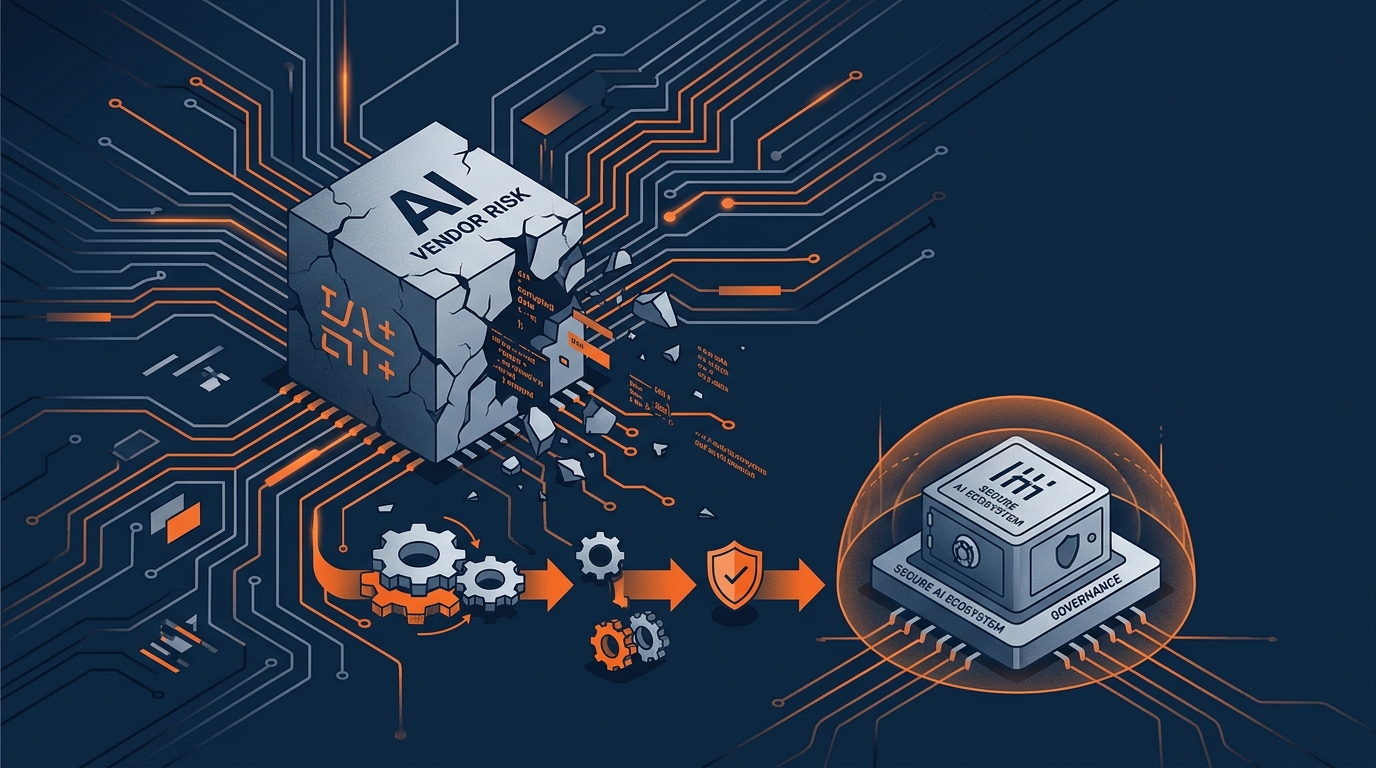
Your Vendors Are a Risk You're Probably Not Watching
Roughly one in three breaches traces back to a third party. Not a hacker who cracked your firewall. A vendor. A SaaS tool. A payment processor. Someone you trusted enough to give access to your systems or your customer data, and then never really checked on again. That's the uncomfortable truth behind most supply chain incidents. It's not that businesses didn't have vendors with problems. It's that nobody was watching closely enough to catch the problem before it became their problem. For small and mid-sized businesses, this is a particularly rough situation. You don't have a dedicated vendor risk team. You might have one person handling IT, compliance, and everything else simultaneously. Annual questionnaires feel thorough until you realize your highest-risk vendor rolled out an AI feature in March, had a quiet security incident in July, and your review isn't until December. By then, you're not doing due diligence. You're doing damage control.
Why Annual Reviews Don't Cut It Anymore
The old model, send a questionnaire once a year, file the PDF, move on, was never great. It's genuinely dangerous now. Vendors change constantly. Ownership changes. Infrastructure changes. AI gets baked into products that previously had nothing to do with AI. New subprocessors get added. And each one of those changes can alter your actual risk exposure without anyone updating the spreadsheet you reviewed last winter. The threat landscape moves faster than annual review cycles. Automated threat intelligence now monitors news, breach reports, regulatory filings, financial disclosures, and technical signals across your vendor ecosystem every single day. Not every December. That shift, from point-in-time to continuous, is the core of what AI-powered vendor risk monitoring actually does.
What These Platforms Actually Do
A lot of vendors in this space throw around the word "AI" without explaining what it means in practice. So here's the plain version. AI-driven vendor risk platforms use machine learning and natural language processing to continuously pull and interpret signals about your suppliers. They scan public and private sources for breach reports, financial stress indicators, regulatory actions, and security disclosures. They ingest your vendors' SOC reports, contracts, and policies and extract what actually matters instead of making a human read a 90-page PDF. They score each vendor based on real-time data and update those scores as conditions change. For SMBs, the value isn't exotic. It's scale. You can monitor dozens or hundreds of vendors without adding headcount, and your limited human attention gets directed at the vendors where risk is actually rising, not distributed evenly across every tool your team uses. AI-powered onboarding is also faster. Companies using these tools cut vendor onboarding cycle times by 70 to 80 percent on average, going from weeks to days without skipping due diligence. And when it comes to detecting compliance or financial risk signals, AI-enabled programs catch problems more than four months earlier than periodic manual reviews. Four months is a meaningful window to make decisions before a crisis.
The AI-Vendor-Inside-Your-Vendor Problem
Here's the piece most SMBs aren't thinking about yet: your vendors now have AI of their own. That SaaS tool your operations team adopted last quarter probably runs on a foundation model from a major provider, processes your business data through it, and has its own set of subprocessors you've never heard of. Your exposure doesn't stop at the vendor. It extends to whoever that vendor depends on. This is what the industry calls nth-party risk, and it's where shadow AI creates real blind spots. A platform might look simple on the surface and carry a surprisingly complex dependency chain underneath. In 2026, a complete vendor risk program includes AI-specific questions. What data does this vendor process through AI? Does that data get used to train models? Who is the underlying model provider? Can you opt out of certain AI features if you need to? These aren't hypothetical compliance questions. They're practical risk questions that didn't exist a few years ago and matter a lot now.
Three Things That Actually Prevent Supply Chain Breaches
Continuous monitoring prevents breaches in three concrete ways, not theoretical ones. First, it gives you time. When an AI-enabled risk score flags a payment processor showing signs of financial distress or unusual security changes, you get a window to act before the incident cascades. Most SMBs find out about vendor problems at the worst possible moment. Continuous monitoring lets you find out earlier, when you still have options. Second, it surfaces concentration risk you didn't know you had. Multiple vendors that look independent might all be running on the same cloud provider or the same underlying model. If that shared dependency fails, several of your critical services go down together. Visibility into that overlap lets you plan around it. Third, it builds the documentation that protects you when something does go wrong. Regulators and customers will ask what you knew and when you knew it. AI-supported vendor risk programs create a defensible record without anyone manually maintaining it.
Where to Start Without Overwhelming Your Team
You don't have to automate everything at once. Start with your highest-risk vendors: the ones who touch sensitive customer data, financial systems, or anything operationally critical. Get those into a continuous monitoring tool before worrying about the rest. Update your vendor contracts to include AI-specific language. Ask about data processing, model training, and subprocessors. It doesn't have to be a legal odyssey. It just has to be in writing. Then let the platform do what it's built to do. Flag the rising risks. Surface the surprises. Keep your attention where it actually needs to be. The businesses that avoid supply chain breaches in 2026 aren't necessarily the ones with the biggest security budgets. They're the ones who stopped treating vendor risk as a once-a-year checkbox and started treating it as an ongoing operational reality.
Free, about two minutes
How much of your busywork could actually be automated?
Answer eight quick questions and get a personalized PDF: your automation score, your top three opportunities, and what they are worth in hours and dollars. No sales call required.
Get your AI Score