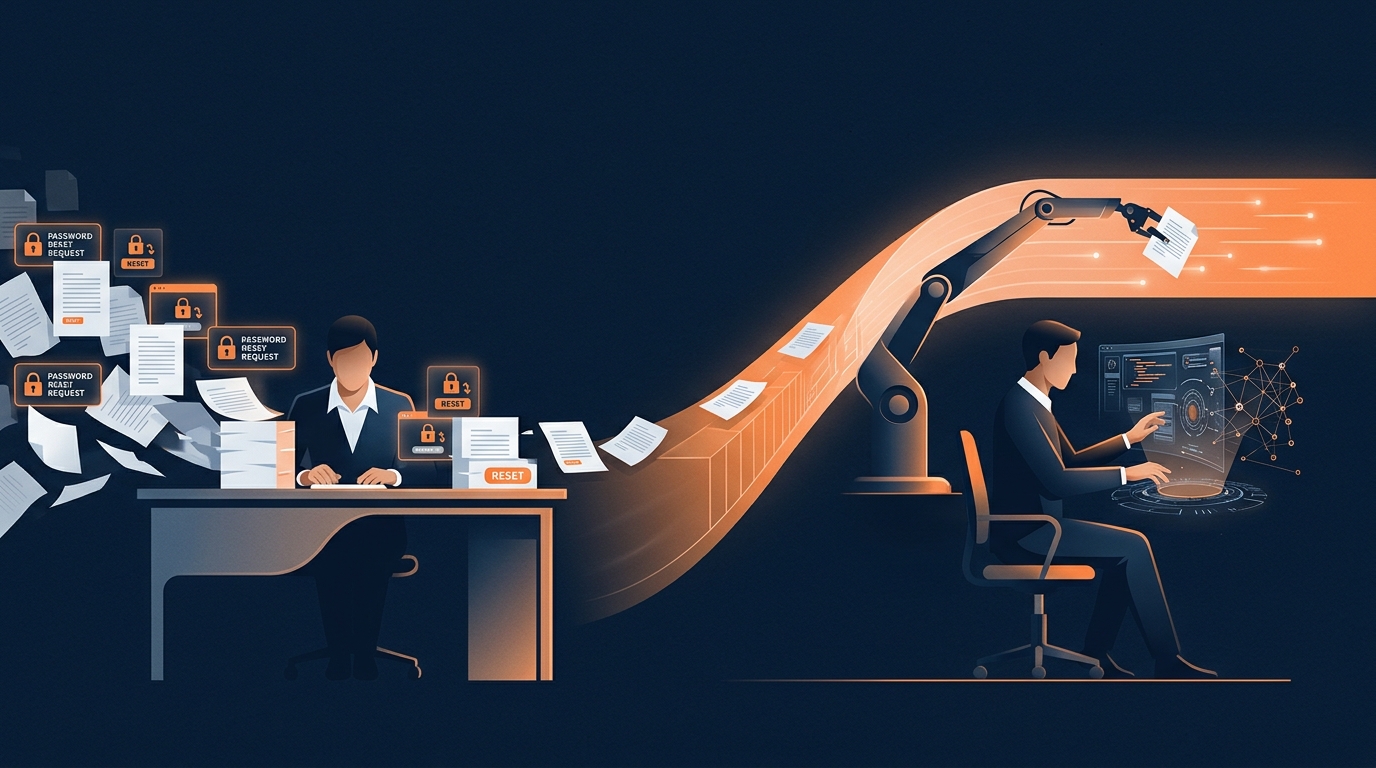
The IT Talent Problem Isn't Going Away
Small and mid-sized businesses have a staffing math problem. CompTIA reports that 52% of IT channel firms are short on critical skills, cybersecurity chief among them. If you're running a lean IT team, or you've got one overworked person wearing six hats, you already know this. Finding experienced IT talent is hard. Keeping them is harder. And every hour your technician spends resetting a password is an hour they're not spending on the things that actually protect your business: patching vulnerabilities, hardening your network, handling compliance, planning for growth. Meanwhile the threats keep stacking up. Ransomware, phishing, insider risk, compliance deadlines that don't care about your staffing situation. You can't out-hire this problem. You have to automate around it.
Most IT Tickets Don't Need a Human
Here's the uncomfortable truth: a huge share of what lands in your IT queue is repetitive, low-risk, and completely predictable. Password resets. Account unlocks. VPN issues. Printer problems. Software install requests. Access requests. Onboarding and offboarding checklists. None of this requires judgment or expertise. It requires speed and consistency, which is exactly what AI-powered service desk tools are built to deliver. A properly configured AI service desk takes requests through email, Microsoft Teams, Slack, or a self-service portal. It classifies the issue, asks clarifying questions if details are missing, checks policy, and either resolves the problem directly or routes it to a technician with full context attached. It can read a screenshot, give location-specific instructions, and update the ticket automatically. No guesswork, no back-and-forth, no waiting for someone to get out of a meeting. The results back this up. Published case studies show AI automating anywhere from 20% to 60% of Tier-1 tickets, depending on documentation quality and integration depth. One service desk case study reported a 40% drop in average resolution time and a 20% jump in daily tickets resolved. Companies like Fundrise and Vidyard report automation rates near 60% and 56% respectively. These aren't theoretical numbers. They're what happens when you stop deflecting tickets to a knowledge base nobody reads and start actually resolving them.
Resolution Beats Deflection, Every Time
A lot of so-called automation just points employees to an article and calls it a day. That's not automation, that's homework. The business case only gets strong when the AI actually fixes the problem: resetting the password, unlocking the account, provisioning the access, documenting the fix. Deflection saves nobody time. Resolution does. And speed matters more than people give it credit for. AI-powered service desks have cut first-response times from hours to minutes on routine requests. Your employees stop sitting around waiting on IT. Your technicians stop repeating the same five-minute explanation for the hundredth time. Everybody wins except the backlog.
Backlogs Hide Bigger Problems
Ticket volume isn't just an annoyance, it's a diagnostic tool if you bother to look at it. Repeated password resets often point to a weak identity-management setup. Recurring VPN or printer complaints usually mean a configuration or hardware issue nobody's fixed properly. AI tools that categorize tickets and track resolution patterns surface these trends automatically, so your team can fix the actual problem instead of patching the same symptom for the fortieth time.
How to Start Without Overcomplicating It
You don't need to automate everything on day one, and you shouldn't try. Pull three to six months of ticket history, find your top ten repetitive requests, and automate those first. Connect the AI to your existing ticketing platform, identity provider, and endpoint management tools. Keep human approval required for anything touching privileged access, financial systems, or sensitive data. The AI should verify identity, enforce least privilege, log everything, and kick anything unusual straight to a human. No exceptions on that last part. Track what matters: percentage of tickets resolved automatically, first-response time, backlog size, repeat-ticket rate, and technician time recovered. These numbers tell you whether the automation is actually working or just looking busy.
The Point Isn't Fewer People
This isn't about replacing your IT team. It's about making the people you already have, the ones you fought hard to hire and can't afford to lose, actually useful for the work only they can do. Automate the repetitive stuff. Let your technicians handle security, infrastructure, and the strategic projects that move your business forward. That's not a nice-to-have anymore. It's how small businesses stay competitive against bigger players with bigger IT budgets.
Free, about two minutes
How much of your busywork could actually be automated?
Answer eight quick questions and get a personalized PDF: your automation score, your top three opportunities, and what they are worth in hours and dollars. No sales call required.
Get your AI Score