The Traffic You're Not Seeing
Here's a number that should bother you: over 90% of the people who visit your website will never fill out a form. They read a blog post, check your pricing page, maybe click through a case study, and then vanish. No name, no email, no record they were ever there. You're left staring at page view counts, which tell you activity happened but nothing about whether it mattered. Meanwhile your small sales team is chasing whoever did convert, regardless of whether that person was actually a good fit. And marketing can't prove ROI because there's no line connecting a visit to a closed deal. That's not a traffic problem. That's a visibility problem.
What AI Actually Fixes Here
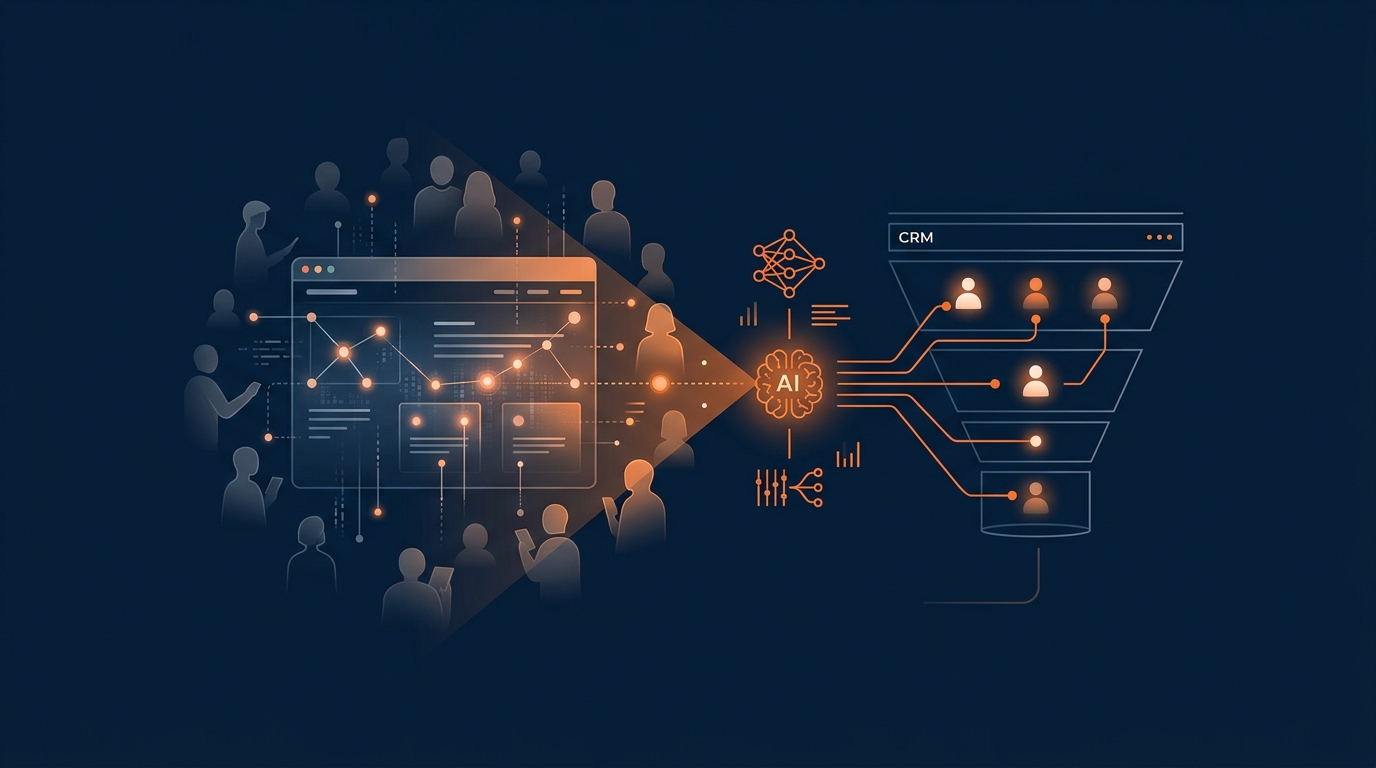
AI-powered website personalization works in three stages: reveal, qualify, segment. None of it requires a bigger team, and none of it requires guessing. First, visitor identification tools use privacy-safe matching to figure out who's likely behind an anonymous visit, even without a form fill. You get company name, industry, size, sometimes even the individual, all pushed straight into your CRM. Suddenly you know that a company matching your ideal customer profile spent four minutes on your pricing page yesterday. That used to be invisible. Now it's a lead. Second, AI lead scoring takes all that raw behavior, pages viewed, time on site, content downloaded, past email engagement, and turns it into a single number that tells you how likely someone is to buy. The model learns from your closed deals over time and gets sharper. No more gut-feel prioritization. Your reps spend time on the leads worth chasing, and close rates go up without adding a single headcount. Third, AI segmentation groups visitors by actual intent instead of vague buckets like "new vs returning." A high-intent buyer circling your pricing page gets a different experience than someone reading a top-of-funnel guide. One might see a "talk to sales" prompt. The other gets a recommended case study. It's not more work for you, it's the website doing the work it should've been doing all along.
What This Looks Like in Practice
A small software company can see which target accounts are browsing its site, route the high-fit ones straight to an outbound rep, and swap in industry-specific case studies automatically. A small ecommerce brand can identify individual visitors, enrich records with contact info, and retarget engaged shoppers without resorting to another annoying popup. AI-powered forms can ask a couple of dynamic questions and instantly sort a lead into a tier that triggers the right follow-up, no manual tagging required. None of this is enterprise-only anymore. Predictive scoring is showing up natively in SMB-friendly CRMs. Visitor identification tools are shrinking down to a simple pixel install. The integrations between your website, CRM, and email tools are easier to wire together than they were even two years ago. The technology caught up to the problem small businesses actually have.
Why This Matters More When You're Small
If you're the owner, the marketer, and half the sales team, you cannot afford to miss the one visitor who came back three times, looked at pricing, and matches your ICP. AI automation watches every visit around the clock and only surfaces the moments that matter. That's the entire point: not more dashboards, fewer distractions. Owners get a clearer read on what's actually working. Marketers finally get data that ties traffic to revenue instead of vanity metrics. Sales reps get shorter lists made up of better leads. Nobody's manually exporting spreadsheets or eyeballing which contact "seems interested." The system already decided that for you, and it did it while you were asleep. Start simple if you want proof this works before you go all in. Identify company-level visitors first. Personalize your CTAs and case studies by industry next. Then layer in AI scoring to decide who gets outreach and who gets retargeted. Each step compounds the last.
The Real Shift Here
This isn't about chasing some futuristic idea of what a website should do. It's about admitting that most of your traffic has been walking past you unnoticed for years, and there's now a straightforward way to stop that. The visitors were always there. The intent was always there. What was missing was a system built to catch it. Small teams don't win by working harder than everyone else. They win by not wasting effort on the wrong people. Let the software handle the watching, scoring, and sorting. Save your time for the conversations that actually close.
Free, about two minutes
How much of your busywork could actually be automated?
Answer eight quick questions and get a personalized PDF: your automation score, your top three opportunities, and what they are worth in hours and dollars. No sales call required.
Get your AI Score